三大高增长行业出海图鉴:中国对外投资新势力(中英双语) | 乾成国际
发布日期:2026-07-30 浏览次数:528
乾成全新专栏「乾成国际」正式上线!
本专栏聚焦企业出海、外商投资领域法律实务,持续分享跨境投资、涉外经营相关热点议题、实务要点与前沿法律观察。本文为「乾成国际」专栏首发文章,欢迎持续关注,一同探讨跨境商事法律问题。
三大高增长行业出海图鉴:中国对外投资新势力
Mapping Three High-Growth Sectors: China’s Outbound Investment Trends
2024年,中国对外直接投资(Outbound Foreign Direct Investment, OFDI)流量达1,922亿美元,同比增长8.4%,连续13年位列全球前三。在众多投资行业中,三大行业投资流量增速位居前列——采矿业(115.2%)、建筑业(80.5%)、信息传输、软件和信息技术服务业(205.5%)。
In 2024, China’s outbound foreign direct investment (OFDI) flows reached US$192.2 billion, representing a year-over-year increase of 8.4%and ranking among the world’s top three for the 13th consecutive year. Among all sectors, three key industries led the growth trajectory: Mining (115.2%), Construction (80.5%), and Information Transmission, Software, and IT Services (205.5%).
2025年,这一势头延续:根据已经披露的部分官方数据,2025年中国全行业对外直接投资1,744亿美元,同比增长7.1%;其中非金融类对外直接投资总额达1,456.6亿美元。各行业具体的投资流量数据尚未发布。
In 2025, thegrowth continued. According to official data released, China’s total outbound direct investment across all sectors reached $174.4 billion in 2025, a year-over-year increase of 7.1%; of this total, non-financial outbound direct investment amounted to $145.66 billion.Statistics regarding Investment flow for each sectors have not yet been released.
2024年中国对外直接投资流量行业构成数据一览
Industry Breakdown of China’s OFDI Flows in 2024
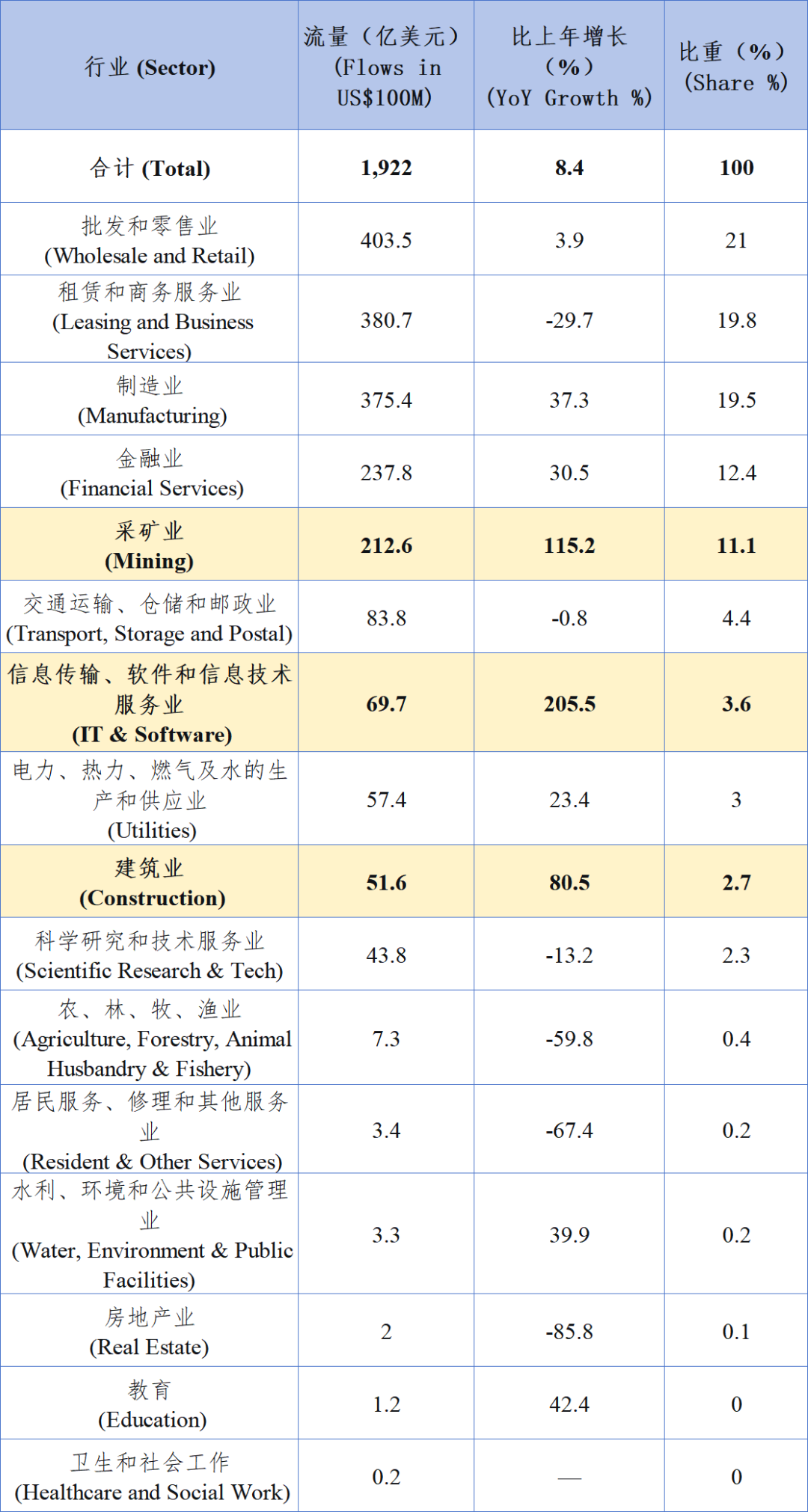
*数据来源:《2024年度中国对外直接投资统计公报》,2025年统计公报尚未发布
*Source: 2024 Statistical Bulletin of China’s Outbound Foreign Direct Investment,
2025 statistics have not yet been released
本文聚焦采矿业、建筑业和信息传输/软件和信息技术服务业三大增速冠军行业,梳理各行业最具代表性的出海目的地,分析核心吸引力,并梳理出各行业的核心法律风险与合规要点。
This article focuses on three fastest-growing sectors—Mining, Construction, and Information Transmission/Software/IT Services—identifies the most representative destinations for each sector, analyzes the key drivers, and outlines the core legal risks and compliance considerations for each sector.
01
采矿业(Mining)
哈萨克斯坦——中亚资源与通道枢纽
Kazakhstan—A Central Asian resource and transit hub
该国拥有丰富的石油、天然气及有色金属资源,是中国在中亚地区的重要投资目的地。截至2024年底,中国对哈萨克斯坦直接投资存量61.8亿美元。据澳大利亚格里菲斯亚洲研究所和上海绿色金融研究中心的研究,哈萨克斯坦成为2025年中国采矿业单一最大投资接收国,投资总额约258亿美元,主要由铝和铜相关项目驱动。中欧班列约85%的陆路过境货运经该国通行,兼具资源开发与战略通道价值。紫金矿业等中企在当地布局金矿等项目。
Rich in oil, gas, and non-ferrous metals, Kazakhstan is a crucial investment destination for China in Central Asia. By the end of 2024, China’s OFDI stock in Kazakhstan stood at US$6.18 billion. According to research by the Griffith Asia Institute in Australia and the Shanghai Green Finance Research Center, Kazakhstan became China’s single-largest recipient of mining investment in 2025, with a total investment of approximately $25.8 billion, driven primarily by aluminum and copper-related projects.Approximately 85% of China-Europe Railway Express land transit cargo passes through Kazakhstan, highlighting its dual value in resource extraction and strategic logistics.. Chinese enterprises including Zijin Mining have deployed gold mining and other projects there.
几内亚——西非铁矿心脏
Guinea—The heart of West African iron ore
西芒杜铁矿是全球储量最大、品质最高的未开发铁矿之一。中企通过中铝铁矿、宝武集团等参与南北两段开发,项目已于2025年底投产。
The Simandou iron ore deposit is one of the world’s largest and highest-grade undeveloped iron ore reserves. Chinese enterprises including Chalco Iron Ore and Baowu Group, participated in the northern and southern blocks with commercial production successfully commencing by late2025.
刚果(金)——全球钴矿主产区
Democratic Republic of the Congo(DRC)—The world’s primary cobalt hub
据美国地质调查局数据,2024年全球钴矿产量约29万金属吨,刚果(金)产量约22万金属吨,全球占比约76%。洛阳钼业在当地运营TFM和KFM两座世界级铜钴矿山,2024年钴金属产量11.42万吨,同比增长106%。
According to U.S. Geological Survey (USGS) data, global cobalt mine production in 2024 reached approximately 290,000 metric tonnes, with the DRC contributing nearly 220,000 metric tonnes—accounting for roughly 76% of global output. CMOC Group operates two world-class copper-cobalt minesin the country (TFM and KFM), producing 114,200 tonnes of cobalt metal in 2024, a year-on-yearincrease of 106% .
战略资源不可替代性:钴、铜、铝土矿、铁矿为中国新能源及制造业刚需,对外依存度较高。
Irreplaceability of Strategic Resources: Cobalt, copper, bauxite, and iron ore represent indispensable raw materials for China’s new energy and manufacturing sectors, which maintain high import dependence.
“一带一路”政策协同:基建互联互通为资源运输提供保障,政策性融资降低投资成本。
Synergy under the Belt and Road Initiative: Cross-border infrastructure connectivity secures logistics for resource transport, while policy financing reduces investment costs.
供应链安全驱动:全球供应链波动下,控制上游资源成为企业核心战略,中企从“买家”向“股东”和“运营商”转变。
Supply chain security imperative: Amid global supply chain volatility, securing upstream resources has become a core corporate strategy, accelerating the shift of Chinese enterprises from “buyers” to “shareholders” and “operators”.
资源民族主义立法:多国修订矿业法,提高矿权费、征收出口税或强推本地加工。例如,刚果(金)2025年2月宣布实施钴出口临时禁令,后多次延长;印尼实施镍矿出口限制。
Resource Nationalism and Regulatory Shifts: Host countries are increasingly revising mining laws to raise royalty fees, impose export duties, or mandate local processing. For example, the DRC announced a temporary cobalt export ban in February 2025, subsequently extended multiple times; Indonesia continues to enforce strict nickel ore export restrictions.
环保合规高压:环评、尾矿管理、生物多样性保护趋严,违规可致停工或巨额罚款。
Stringent environmental compliance: Environmental impact assessments, tailings management, and biodiversity protection are under heightened regulatory scrutiny. Non-compliance risks operational suspension or severe administrative fines.
社区土地权属纠纷:当地社区土地权利、安置补偿具有法律约束力,纠纷常演变为诉讼或行政制裁。
Community land rights and social license: Local community land rights and resettlement compensation carry legal force. Land disputes frequently escalate into judicial litigation or regulatory sanctions.
投资保护条约适用:需评估双边投资协定(BIT)的保护范围,确保征收补偿、投资者-国家争端解决机制(ISDS)条款可用。
Applicability of investment treaty: It is necessary to assess the scope of protection under bilateral investment treaties (BITs), to ensure that expropriation compensation and investor-state dispute settlement (ISDS) mechanisms are available.
矿产能源项目投资大、周期长、政策敏感,矿权、环保、社区及投资保护机制的稳定性往往比资源本身更值得关注。投资架构设计不当可能导致BIT保护落空,建议在交易前期即评估ISDS机制的可适用性。
Mining and energy projects are characterized by heavy capital commitment, extended payback periods, and high policy sensitivity. The legal stability of mining concessions, environmental compliance, community engagement, and investment protection frameworks often outweighs the intrinsic value of the underground reserves. Flawed investment structuring may forfeit BIT protections; thus, assessing ISDS applicability during early-stage deal structuring is highly recommended.
02
建筑业(Construction)
尼日利亚——非洲最大经济体
Nigeria—Africa’s largest economy
基建缺口覆盖电力、交通、港口。中企参与公路、铁路、电力EPC项目。2024年中国企业在尼新签承包工程合同185份,新签合同额77.6亿美元,完成营业额34.5亿美元。据复旦大学绿色金融与发展中心与格里菲斯亚洲研究所的报告,尼日利亚2025年“一带一路”建设合同价值大幅增长至246亿美元,主要驱动力为奥吉迪格本天然气革命工业园(GRIP)项目。
Addressing massive infrastructure deficits in power, transport, and port facilities, Chinese contractors are deeply involved in regional road, rail, and energy EPC projects. In 2024, Chinese enterprises signed 185 new engineering contracts in Nigeria valued at US$7.76 billion, delivering a completed turnover of US$3.45 billion.According to a report by Fudan University’s Center for Green Finance and Development and the Griffith Asia Institute, the value of Nigeria’s “Belt and Road” construction contracts surged to $24.6 billion by 2025, propelled primarily by the Ogidi-Digben Gas Revolution Industrial Park (GRIP) project.
刚果(布)——中非基建市场
Republic of the Congo—A Central African infrastructure hub
中国路桥等企业在当地承建基础设施项目。2024年中国对刚果(布)承包工程完成营业额10.6亿美元,较上年增长43.2%。
Contractors such as China Road and Bridge Corporation (CRBC) have executed key transport and municipal infrastructure projects there.In 2024, Chinese contractors achieved a completed turnover of US$1.06 billionin the Republic of Congo reached,marking, a 43.2%year-on-yearincrease.
沙特阿拉伯——“2030愿景”驱动经济多元化
Saudi Arabia—Driven by Vision 2030 for economic diversification
沙特阿拉伯于2016年提出的经济改革计划(“2030愿景”),旨在通过经济多元化减少对石油依赖。该计划与中国“一带一路”倡议形成战略对接,目前沙特已成为中国承包商在中东和北非地区最大的市场。中国建筑、中国电建等企业在当地签约多个大型项目。
Saudi Arabia’s economic reform plan, “Vision 2030,” launched in 2016, aims to reduce dependence on oil through economic diversification. The plan aligns strategically with China’s “Belt and Road” Initiative, making Saudi Arabia the largest market for Chinese contractors in the Middle East and North Africa. Major state-owned contractors, includingChina State Construction Engineering Corporation and PowerChina have signed multiple large-scale projects there.
伊拉克——战后重建需求巨大
Iraq—Massive post-war reconstruction demand
中国电建等企业在当地承建学校、电力等基础设施。2024年1-12月中国与伊拉克新签承包工程合同额92.7亿美元,同比增长75.2%。
Chinese enterprises like PowerChina are actively constructing school, power, andmunicipal infrastructure.From January to December 2024, new Chinese engineering contract values in Iraq reached US$9.27 billion, representing a 75.2%year-on-yearsurge.
基建缺口巨大:各国交通、能源、市政设施严重不足,城市化进程加速带来旺盛需求。
Severe deficiencies in regional transportation, power generation, and municipal utilities, combined with rapid urbanization, generate sustained demand for capital projects.
“一带一路”项目驱动:中国提供优惠贷款和工程总承包服务,形成“资源换基建”或“贷款换工程”模式。
Belt and Road project momentum: Concessional loans and integrated EPC services provided by Chinese institutions enable structured “resources-for-infrastructure” or “loans-for-projects” models.
能源收入支撑还款:东道国多依赖石油、天然气等资源出口偿付工程款,中企需评估其财政可持续性。
Energy revenue-backed repayment: Host countries often rely on oil, gas, and other resource exports to service engineering project debts, requiring Chinese contractors to rigorously evaluate long-term fiscal sustainability.
本地用工强制比例:多国劳动法要求外企雇佣一定比例本地劳工,违者面临罚款、停标或驱逐出境。
Mandatory Local Content Requirements (LCR): Domestic labor laws mandateminimum ratiosfor local workforce hiring, with violations subject to fines, bidding disqualification, or deportation.
技术标准准入壁垒:业主常用美标、英标、欧标,与中国标准差异大,设计变更和验收风险陡增。
Technical standard barriers: Owners commonly use US, British, or European standards, which differ significantly from Chinese standards, significantly increasing design change and handover risks.
EPC合同法律陷阱:价格调整、延期罚款、不可抗力条款需精细谈判;当地分包商违约或劳动争议可能传导至总包方。
Legal Pitfalls in EPC contracts: Price adjustments, liquidated damages for delay (LDs), and force majeure clauses require careful negotiation; defaults by local subcontractor or labor disputes can directly spill over to the general contractor.
政治风险与安全法律:政局不稳、恐怖主义、制裁等属不可抗力,需合同明确风险分配,并购买政治风险保险。
Political risk and security law: Political instability, terrorism, and sanctions constitute force majeure events; contracts must clearly allocate such risks, supported by comprehensive political risk insurance.
国际工程承包法律风险密集,合同管理贯穿全生命周期。建议在投标阶段即审查招标文件中的特殊条款,在EPC合同中明确约定国际仲裁管辖,将政治风险保险作为标配。
International engineering contracting is legally risk-intensive, requiring lifecycle contract risk management. It is advisable to review special clauses in tender documents at the bidding stage, specify international arbitration jurisdiction in EPC contracts, and incorporate political risk insurance as standard risk mitigation.
03
信息传输、软件和信息技术服务业(ICT)
新加坡——东南亚数字枢纽
Singapore—Southeast Asia’s digital hub
完善的法律体系、国际化人才、低税率,是中企辐射东盟及中东的桥头堡。博彦科技等企业在当地布局。
A robust legal framework, a global talent pool, and competitive tax rates make it the premier regional headquarter for Chinese enterprises expanding into ASEAN and the Middle East. Companies such as Beyondsoft have established operations there.
匈牙利——欧洲数字门户
Hungary—Europe’s digital gateway
作为欧盟成员国,是中企进入欧洲的战略跳板。据匈牙利投资促进局数据,2025年中国对匈牙利直接投资达39.7亿欧元,占匈牙利全年吸引外资总额的57%,中国蝉联匈牙利最大外资来源国。
As an EU member state, it serves as a strategic launchpad for Chinese enterprises entering Europe.According to the Hungarian Investment Promotion Agency, China’s direct investment in Hungary reached €3.97 billion in 2025, accounting for 57% of Hungary’s total foreign capital inflow, making China Hungary’s largest foreign investor for the second consecutive year.
瑞典——北欧创新中心
Sweden—A Nordic innovation center
通信、AI、清洁技术研发全球领先,中企通过投资获取前沿技术与高端人才。
Globally leading in telecommunications, AI, and clean technology R&D, it offers Chinese enterprises access to cutting-edge technology and high-end talent through targeted investment.
人才与创新生态优越:目的地汇聚全球顶尖高校和研发机构,可获取稀缺技术人才。
Superior talent and innovation ecosystems: Destinations feature world-class universities and R&D institutions, providing access to highly specialized technical talent.
市场辐射能力强:新加坡辐射东盟及中东,匈牙利辐射欧盟单一市场,瑞典辐射北欧及波罗的海区域。
Strategic Regional Connectivity: Singapore acts as a gateway to ASEAN and the Middle East; Hungary connects directly to the EU single market; Sweden offers access across Nordic and Baltic regions.
法治与IP保护完善:稳定的法律体系和成熟的判例法,为技术合作、知识产权保护和商业纠纷提供高度可预期性。
Sound rule of law and IP protection: Stable legal systems and mature case law provide high predictability for technology cooperation, intellectual property protection, and commercial dispute resolution.
数据主权与跨境限制:欧盟《通用数据保护条例》(GDPR)对向第三国传输个人数据设严格条件,违规可处全球营业额4%罚款。新加坡《个人数据保护法》(PDPA)、中国《数据安全法》域外效力同样需关注。
Data sovereignty and cross-border restrictions: The EU General Data Protection Regulation (GDPR) imposes strict conditions on transferring personal data to third countries, with statutory fines up to 4% of global turnover. Extraterritorial compliance under Singapore’s Personal Data Protection Act (PDPA) and China’s Data Security Law demands close oversight.
技术出口管制与制裁:美国商务部工业与安全局(BIS)对半导体、AI算法等实施出口管制;欧盟两用物项管制条例亦趋严格。
Technology export controls and sanctions: The US Bureau of Industry and Security (BIS) imposes export controls on semiconductors, AI algorithms, and other technologies; the EU Dual-Use Regulation continues to tighten compliance requirements.
外资安全审查:美国外国投资委员会(CFIUS)、欧盟外国直接投资(FDI)审查不断扩大范围,涉及关键技术、基础设施、敏感数据的交易须事先申报。
Foreign investment reviews: Screening mechanisms like CFIUS in the U.S. and FDI screening frameworks across EU member states continue to expand; transactions involving critical technologies, infrastructure, or sensitive data require prior notification.
知识产权侵权风险:软件专利、开源许可合规、商业秘密保护在各法域规则差异大,海外诉讼成本高昂。
Intellectual property infringement risks: Software patents, open-source license compliance, and trade secret protection vary significantly across jurisdictions, with overseas litigation costs posing significant cost risks.
科技行业面临数据、知识产权、出口管制三重风险交织的监管环境。建议开展全球数据治理差距分析,对技术转让中的知识产权归属清晰约定,并提前评估投资标的是否落入安全审查范畴。
The technology sector operates in a regulatory nexus where data, intellectual property, and export control closely intersect. It is advisable to conduct a global data governance gap analysis, clearly define IP ownership in technology transfers, and proactively assess FDI screening applicability prior to deal execution.
04
结语(Conclusion)
2024年,中国对外直接投资在采矿业、建筑业和信息传输/软件和信息技术服务业呈现显著增长态势。企业在把握出海机遇的同时,需将法律合规能力作为投资决策的核心变量之一,以降低投资风险。
In 2024, China’s outbound direct investment demonstrated robust growth momentum across the mining, construction, and information transmission/software/IT services sectors. As enterprises capitalize on global expansion opportunities, embedding international legal compliance as a strategic variable in investment decision-making remains vital to mitigating cross-border operational risks.
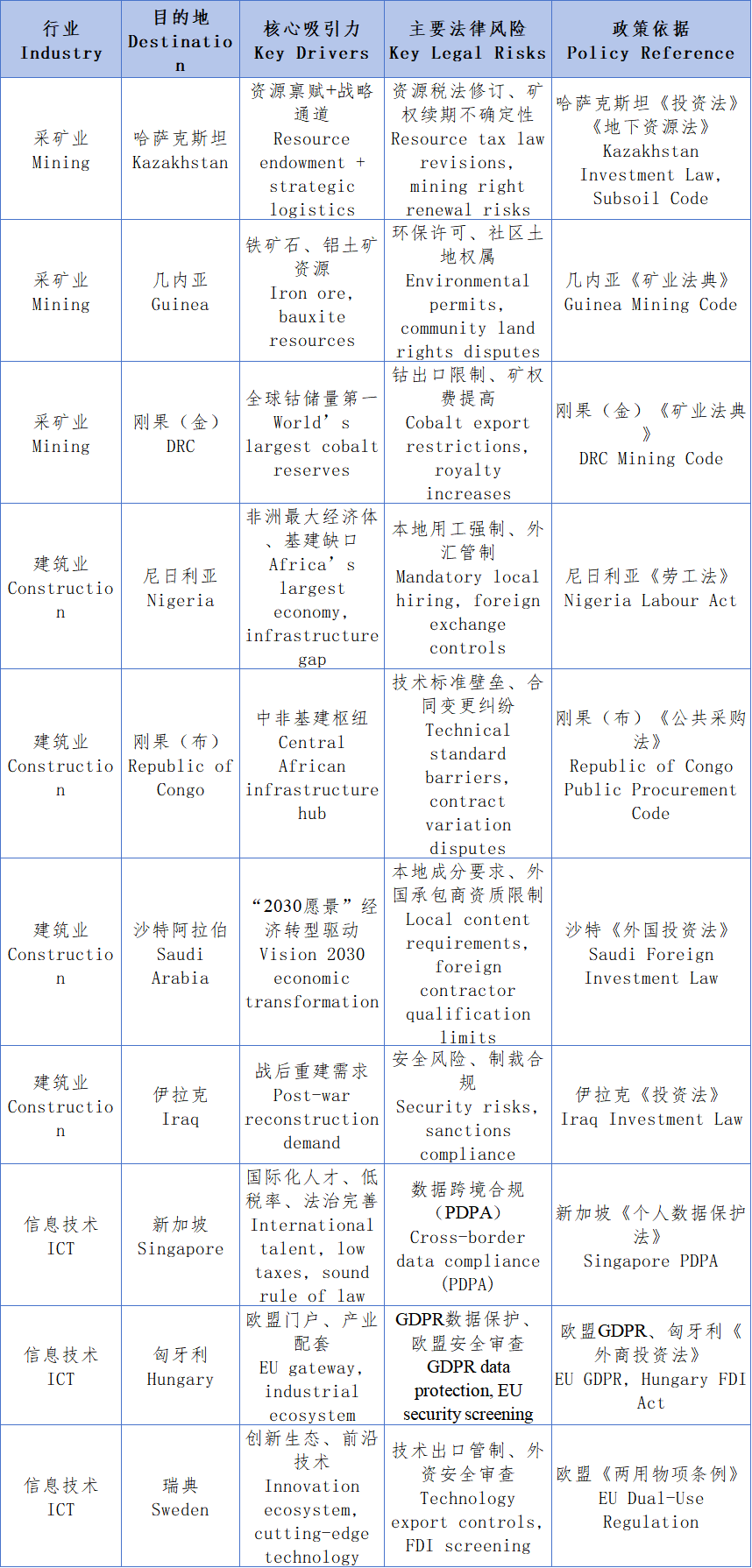
附录:三大行业出海目的地速览
Appendix: Quick Guide to Key Destinations
资料来源(Sources):
1. 商务部、国家统计局、国家外汇管理局《2024年度中国对外直接投资统计公报》(2025年9月8日发布)
Ministry of Commerce of the PRC, National Bureau of Statistics, State Administration of Foreign Exchange: 2024 Statistical Bulletin of China’s Outbound Foreign Direct Investment (September 8, 2025)
2. 商务部《2024年我国对外承包工程业务简明统计》(2025年1月26日发布)
Ministry of Commerce of the PRC: 2024 Summary Statistics of China’s Overseas Contracted Engineering Business (January 26, 2025)
3. 商务部合作司《2025年中国对外投资合作运行情况》(2026年1月30日发布)
Department of International Cooperation, Ministry of Commerce: 2025 China’s Outbound Investment and Cooperation Operations (January 30, 2026)
4. 中国驻伊拉克大使馆经济商务处《2024年1-12月中国与伊拉克主要经贸数据》
Economic and Commercial Office, Chinese Embassy in Iraq: China-Iraq Key Economic and Trade Data, January–December 2024
5. 中国驻尼日利亚大使馆经商处《对外投资合作国别(地区)指南:尼日利亚(2025年版)》
Economic and Commercial Office, Chinese Embassy in Nigeria: Guide to Outbound Investment and Cooperation by Country (Region): Nigeria (2025 Edition)
6. 新华社《中国2025年蝉联匈牙利最大外资来源国》(2026年1月9日)
Xinhua News Agency: China Remains Hungary's Largest Foreign Investor in 2025 (January 9, 2026)
7. 匈牙利投资促进局(HIPA)2025年投资数据
Hungarian Investment Promotion Agency (HIPA) 2025 Investment Data
8. 美国地质调查局(USGS)2024年全球钴矿产量数据
U.S. Geological Survey (USGS) 2024 Global Cobalt Mine Production Data
9. 复旦大学绿色金融与发展中心与格里菲斯亚洲研究所BRI建设参与报告
Fudan University Center for Green Finance and Development & Griffith Asia Institute: BRI Engagement Report
10. 澳大利亚格里菲斯亚洲研究所与上海绿色金融研究中心研究报告
Griffith Asia Institute & Shanghai Green Finance Research Center: Joint Outbound Mining Investment Report